


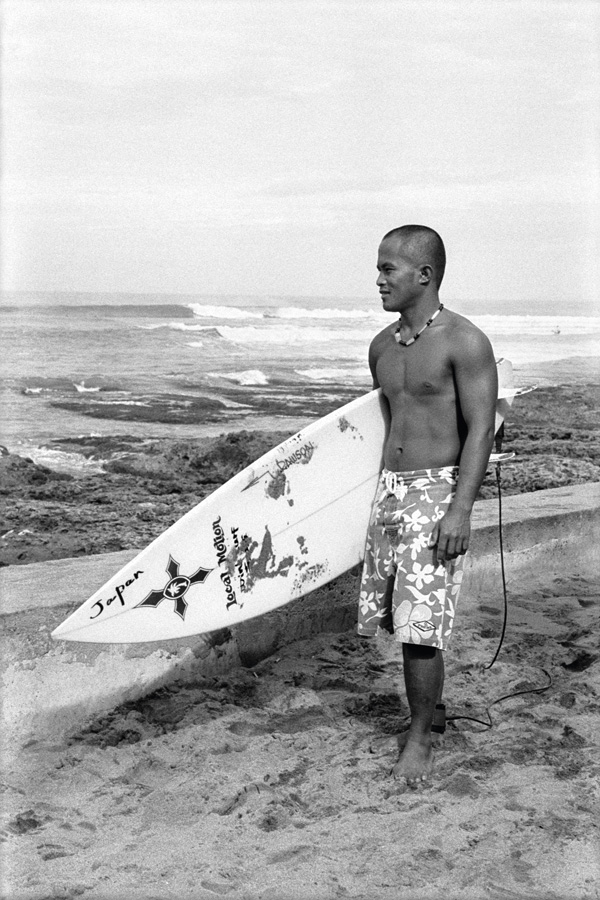


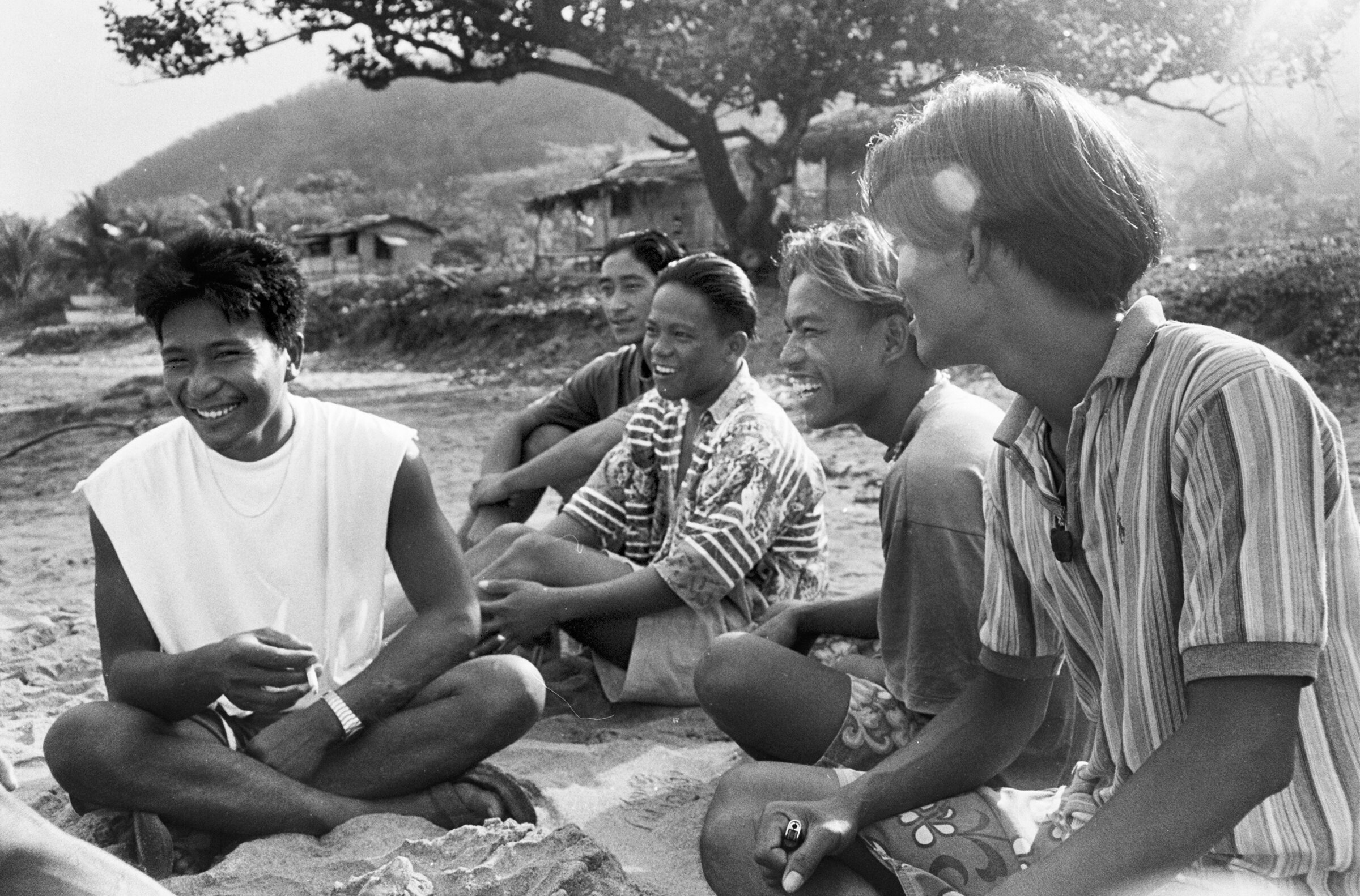


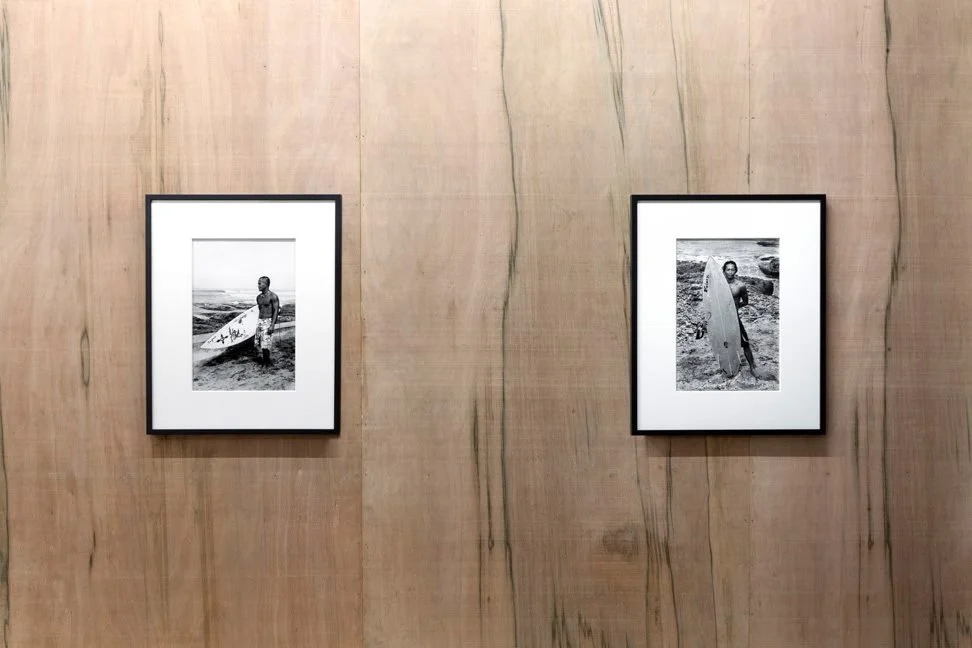
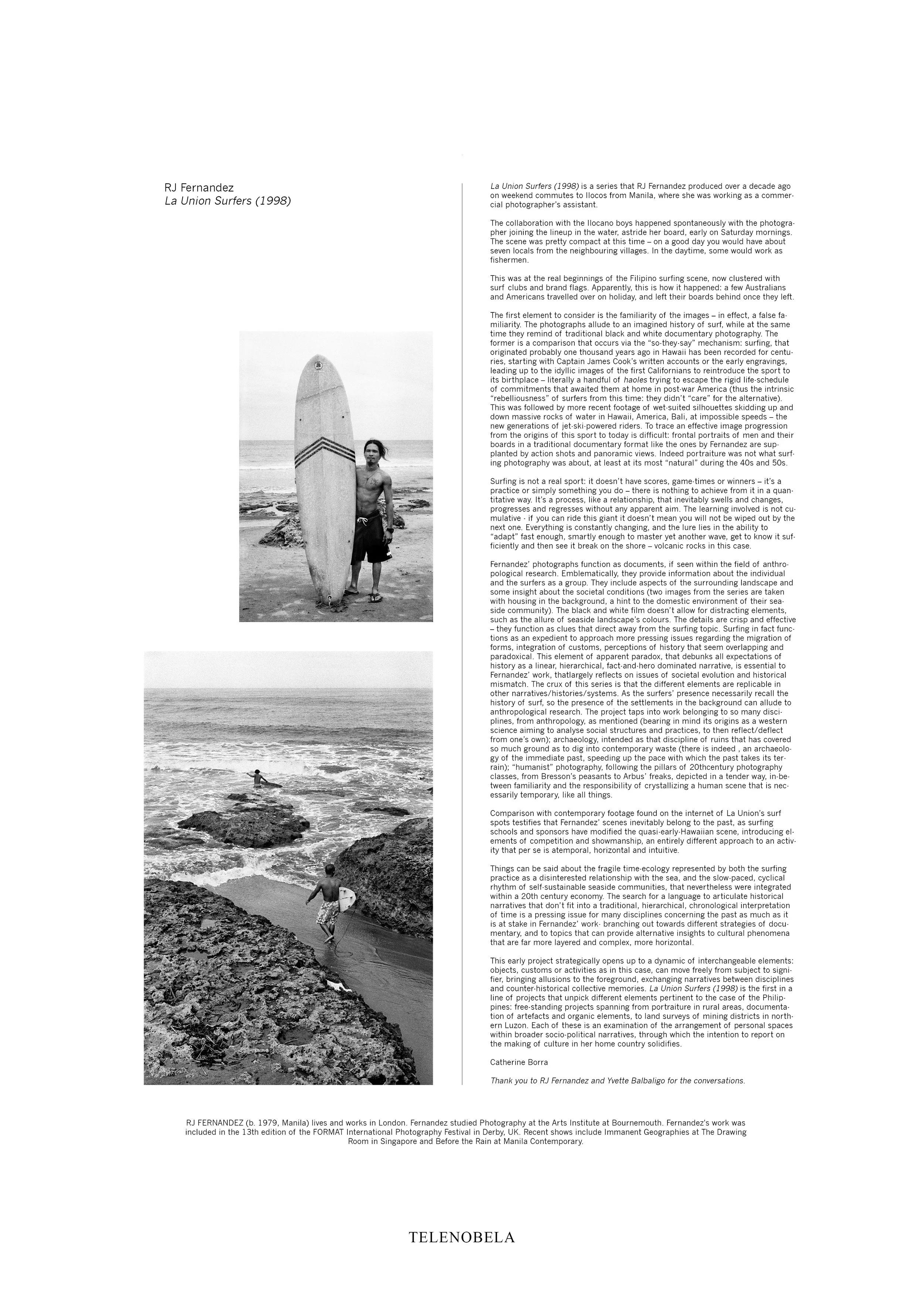
La Union Surfers is a series that RJ Fernandez produced over a decade ago, on weekend commutes to Ilocos from Manila, where she was working as a commercial photographer's assistant.
Surfing is not a real sport: it doesn't have scores, game-times or winners – it's a practice or simply something you do – there is nothing to achieve from it in a quantitative way. It's a process, like a relationship, that inevitably swells and changes, progresses and regresses without any apparent aim. The learning involved is not cumulative - if you can ride this giant it doesn't mean you will not be wiped out by the next one. Everything is constantly changing, and the lure lies in the ability to “adapt” fast enough, smartly enough to master yet another wave, get to know it sufficiently and then see it break on the shore – volcanic rocks in this case.
…
Fernandez' photographs function as documents, if seen within the field of anthropological research. Emblematically, they provide information about the individual and the surfers as a group. They include aspects of the surrounding landscape and some insight about the societal conditions (two images from the series are taken with housing in the background, a hint to the domestic environment of their seaside community). The black and white film doesn't allow for distracting elements, such as the allure of seaside landscape's colours. The details are crisp and effective – they function as clues that direct away from the surfing topic. Surfing in fact functions as an expedient to approach more pressing issues regarding the migration of forms, integration of customs, perceptions of history that seem overlapping and paradoxical. This element of apparent paradox, that debunks all expectations of history as a linear, hierarchical, fact-and-hero dominated narrative, is essential to Fernandez' work, that largely reflects on issues of societal evolution and historical mismatch.