Vanua
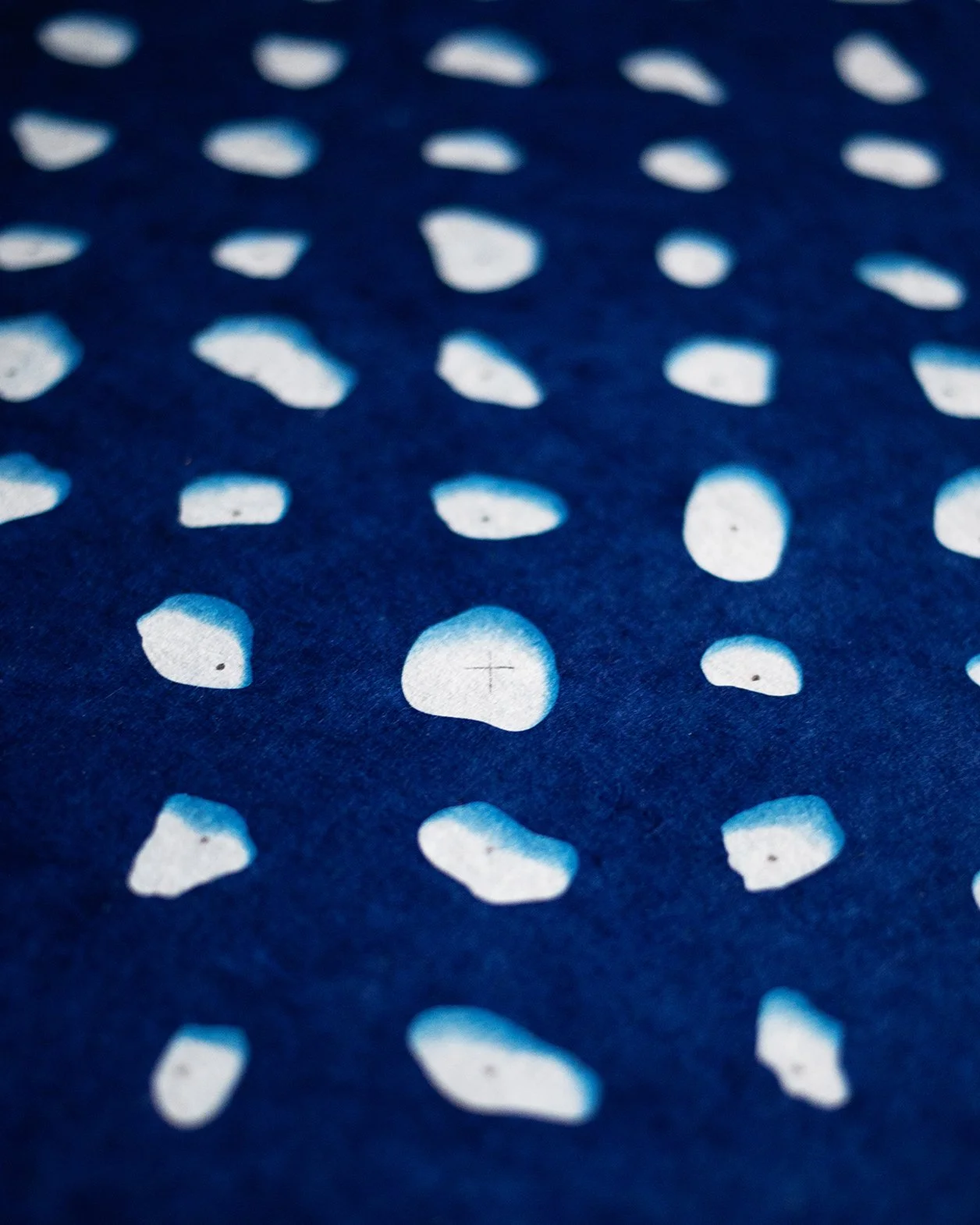
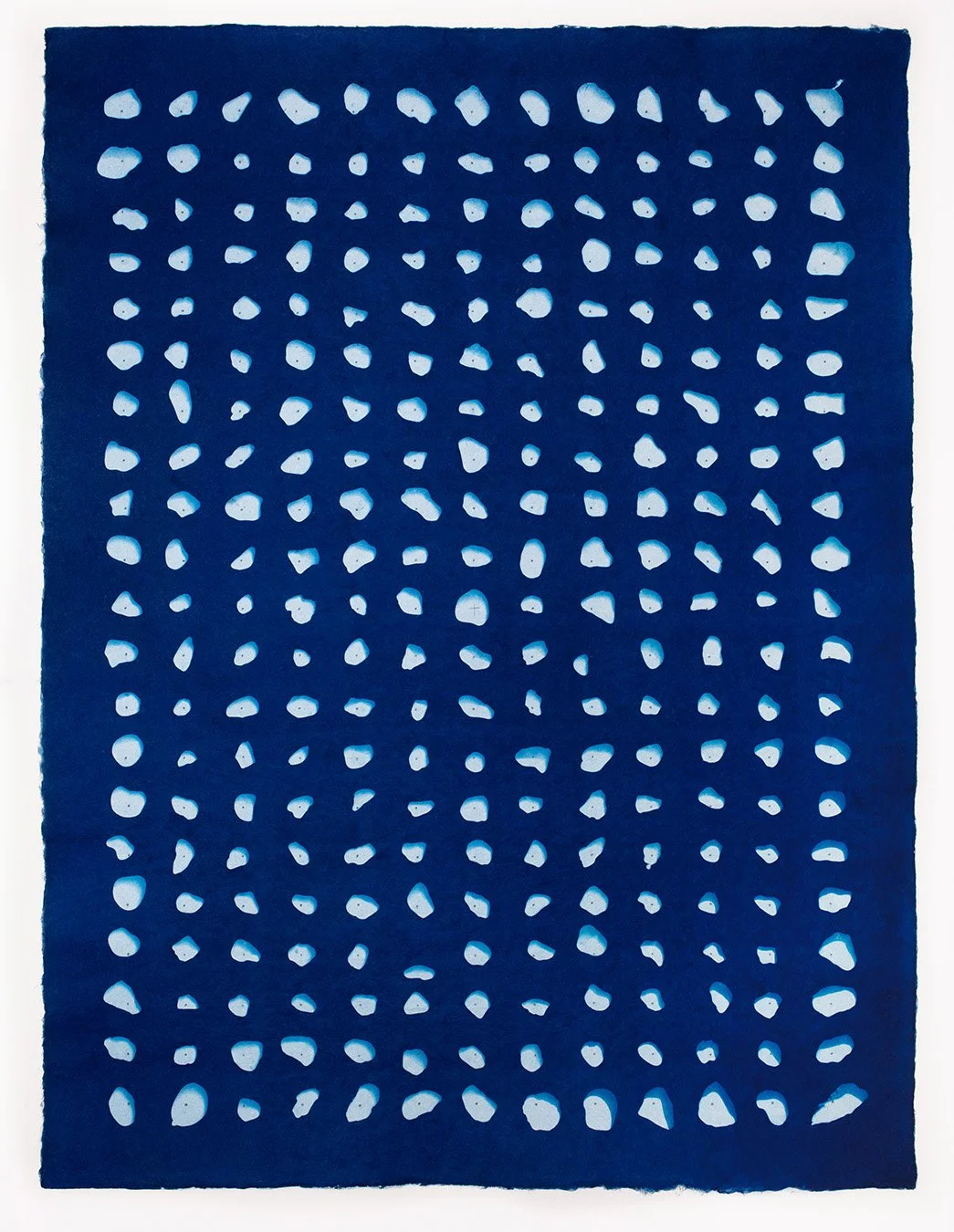
The process, in the studio, is its own kind of discipline. A metal plate, pierced with small holes, is laid over a sheet of piña paper, and a pencil is worked through each hole in turn — one dot, then the next, then the next, until a grid of hundreds of marks covers the sheet. Only once the grid is complete is the paper coated in cyanotype chemical. Then shingle gathered from the Hastings shoreline is set down stone by stone, a single piece placed on every marked point, the whole grid filled by hand, across an afternoon, one stone following the last. Exposed at a specific time of day, low light casts a shadow around each stone as it blocks the sun, leaving behind its shape and a faint halo of graduated blue. The grid gives the sheet its order — a fixed, exact number of stones, countable to the last one — but what the eye finds first is the opposite: hundreds of small variations, no two shadows quite alike, each one chosen and placed with the same close attention as the last. Not a single image, then, but a field of individual acts, laid down one at a time.
Each cyanotype is unique. The process is continuous as a process of meditation.
Let me tell you a myth — not one I was told, but one I made up. Like most origin stories, it begins with a feeling of not knowing. This one is about the ground beneath my feet, about how shingle came to be.
On Batanes, a small island of rolling hills and towering cliffs, lives an ethnolinguistic group called the Ivatan. The Ivatan are seafarers, and their word "vanua" translates literally to a port — not a harbour built, but a natural opening, a safe passage found through hazardous, rocky shorelines and coral reefs, the place where a boat can still reach the sea. It also means, at once, "place" and "land". In the wider Austronesian languages, it also means "town" or "center"; its synonym "bayan" translates to the "motherland". Language reveals the way the Ivatan inhabit both realms.
After each successful fishing, a glass bead is offered to the sea in thanks. Like the makings of a vanua, each bead was chosen through ritual. Over time, these beads sank, were pressed by tides, turned to stone, and were washed back on shore. And that, perhaps, is how shingle came to be.
But on this island, the movement of shingle is restricted. Its passage blocked by strategically placed groynes — unmoving soldiers, protecting the land from being reshaped by incoming rocks. I watch as a fleet of excavators moves them from one side of the shore to the other — a Sisyphean task. Still, the shingle drifts. Like desire paths — unofficial routes created by people against design — shingle shifts, it resists. Movement persists.